
Auckland Diwali Festival 2026: Complete Guide to Events, Food, Fireworks and Visiting Auckland
Auckland Diwali Festival 2026 on 31 October and 1 November: dates, free entry, food, performances, fireworks, transport, weather and visitor tips.
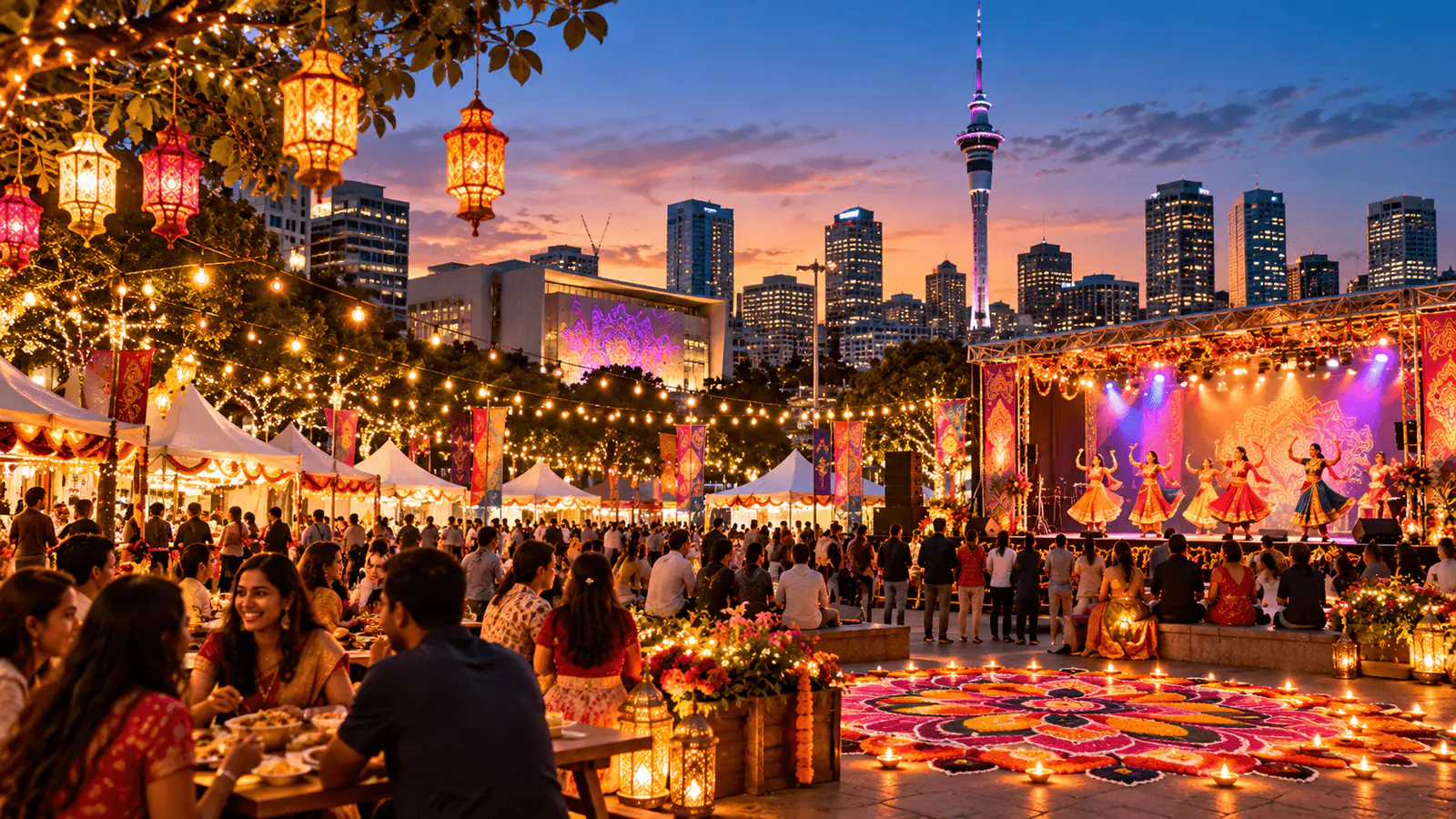
Conceptual illustration (AI-generated). Not a photograph of the actual festival.
Every year, Auckland's central city fills with colour, music, incense-scented food smoke and thousands of lights for one of the largest Indian cultural celebrations in the Southern Hemisphere. The Auckland Diwali Festival, presented by BNZ, takes over Aotea Square and the streets around it for a weekend that mixes dance, street performance, food, markets, art installations and a Sunday-evening fireworks finale, and it is free to attend.
This guide is written for people planning to be in Auckland for the 2026 festival, whether you live in the city, are visiting from elsewhere in New Zealand, or are travelling from overseas. It sets out what the organisers have published, separates confirmed details from things that are still to be announced, and covers the practical questions that decide whether a festival visit goes smoothly: how to get there, what the weather is usually like, where to stay and what else to do in the city. Details for 2026 are taken from the festival organiser's published information as at mid-October 2026, and schedules can change, so check the official programme in the days before you go.
Auckland Diwali Festival 2026 at a Glance
| Item | Details | Confirmation status |
|---|---|---|
| Dates | Saturday 31 October and Sunday 1 November 2026 | Confirmed by the festival organiser |
| Location | Aotea Square, Queen Street, Rutland Street and surrounding central Auckland venues; marketplace entered from Rutland Street | Confirmed in the organiser's release |
| Opening hours | Saturday 12pm to 9pm; Sunday 12pm to 9.10pm | Per the Tātaki Auckland Unlimited release (21 Sep 2026); the festival page lists 12pm to 9pm on both days, so confirm |
| Admission | Free entry | Confirmed by the organiser |
| Organiser | Tātaki Auckland Unlimited, as an Auckland Council event, presented by BNZ, with advice from the Diwali Advisory Group | Confirmed by the organiser |
| Fireworks | Sunday evening, expected to begin at approximately 8.50pm, followed by a projection show on Auckland Town Hall | Per the release; the time is approximate, not guaranteed; the festival page gives no time |
| Accessibility details | Not stated on the organiser pages reviewed | Unknown: check the festival information page |
What Is Diwali and Why Is It Celebrated in Auckland?
Diwali, often called the Festival of Lights and the reason for the many Diwali events in Auckland each spring, is one of the most important festivals in Hindu tradition and is also observed by Sikh, Jain and some Buddhist communities, each with their own stories and customs. New Zealand Diwali celebrations include public festivals like Auckland's and community events at temples and halls. For many people the festival marks the triumph of light over darkness and good over evil, and it is a time for cleaning and decorating homes, lighting lamps, sharing sweets, wearing new clothes and gathering with family. The festival's date follows a lunar calendar, so it moves each year against the Gregorian calendar. In 2026 the main Diwali day, Lakshmi Puja, falls on Sunday 8 November, according to published Diwali calendars, with the wider five-day observance running around it.
That means the Auckland festival weekend on 31 October and 1 November comes a little before Diwali itself. This is normal for large public festivals, which are scheduled for weekends when the most people can attend, and it is worth knowing if you are visiting for religious observance rather than the public event. Temples and community groups hold their own celebrations on and around the actual Diwali date, and those are separate from the city centre festival.
Auckland's Indian communities and the festival's history
Visiting respectfully
Auckland Diwali Festival 2026 Dates, Location and Schedule
The festival runs on Saturday 31 October and Sunday 1 November 2026. According to Tātaki Auckland Unlimited's release of 21 September 2026, it runs from midday to 9pm on Saturday and from midday to 9.10pm on Sunday. The festival's own page lists 12pm to 9pm for both days, a small difference, so plan around 9pm on Saturday and about 9.10pm on Sunday, and check the festival page for any change. The main festival takes place in Aotea Square, Queen Street, Rutland Street and surrounding central Auckland venues, and the festival marketplace is entered from Rutland Street. Entry to the main festival is free.
The organiser's page lists the types of activity but does not publish a minute-by-minute schedule for every stage. Performer lineups and stage timings are normally released closer to the festival, so the practical advice is to arrive early in the afternoon to find your bearings, pick up the printed or online programme, and then plan around the acts you most want to see. If a specific performance matters to you, check the official programme on the day rather than relying on a third-party listing.
Related events in the days around the festival
Cultural Performances, Dance and Entertainment
Performance is at the centre of the festival. The organiser describes cultural celebrations of music and dance, street performances across the city streets, and creative workshops, and Auckland's tourism guide adds that the programme includes both traditional and contemporary live music and dance. Festivals of this kind commonly bring together classical, folk, Bollywood-style and contemporary forms, but which specific groups and styles appear in 2026 is a matter for the published performer lineup, and the organiser's performer pages are the place to check.
Street performances are an important part of the atmosphere because they move through the festival rather than staying on one stage. That makes the event easier for visitors with limited time: even a short visit passes performers, stalls and displays. The festival also lists a Living Arts Centre, described as a shared space to relax and create, and yoga and wellness sessions, which gives the weekend a calmer side for those who want a break from the crowds.
Festival of Lights, Decorations and Fireworks
Fireworks: what is confirmed and what is not
Indian Food, Sweets and Festival Market Stalls
Food is a major reason many people come, and the Auckland Diwali food stalls are one of the festival's best-known attractions. The organiser's page lists authentic food from India and beyond, with pakora, pav bhaji and kulfi mentioned by name, and a Festival Marketplace selling handmade crafts, clothing and gifts. Auckland's tourism guide says the festival is vegetarian-focused and that the 2026 food stalls serve vegetarian dishes made without eggs, which is useful information for visitors with dietary requirements. It also mentions henna artists and creative workshops.
A few practical points help. Queues at popular stalls can be long, particularly in the early evening, so eating early or sharing dishes lets you try more. Carry cash and a card, as stall payment methods vary, and look for water and rubbish arrangements on site rather than assuming. If you have allergies, ask stallholders directly about ingredients, because a vegetarian label does not cover nuts, dairy, gluten or other allergens.
Indian restaurants near the festival
Best Things for Families and First-Time Visitors
The festival is designed as a family event, and the organiser lists family fun activities and creative workshops. Because admission is free and visitors can come and go, families can plan a short visit around naps and mealtimes, and many choose the earlier part of the afternoon when crowds are lighter. For children, the combination of colour, music, henna art, workshops and food tends to be the draw. Our guide on whether children and babies need an NZeTA is useful if you are travelling to New Zealand with young children.
First-time visitors, particularly those unfamiliar with Diwali, will get more from the day with a simple plan. Walk the full site once to see what is on, then return to the stages or stalls that interest you. Learn the basics beforehand, as in the section above, so that decorations and performances make sense. Be ready for crowds and noise, and agree a meeting point with your group in case phone coverage is poor in a dense crowd.
- Arrive in the early afternoon for lighter crowds and a calmer introduction
- Walk the whole site first, then choose performances and stalls
- Agree a meeting point and keep valuables secure in busy areas
- Bring a refillable bottle, sun protection and a warm layer for the evening
- Ask before photographing people, and respect performers and worshippers
How to Reach the Festival by Public Transport
Public transport is the sensible way to reach the central city on a festival weekend. The organiser says Aotea Square is about a three-minute walk from Te Waihorotiu Station, which is served by the South–City and East–West lines, and about a 15-minute walk from the Downtown Ferry Terminal. Auckland's tourism guide describes the walk from Te Waihorotiu Station, using the Wellesley Street entrance, as about five minutes, so allow three to five minutes. Other City Rail Link stations within reach are Waitematā (Britomart), Karanga-a-Hape (K' Road) and Maungawhau (Eden Terrace). Frequent buses from the North Shore have stops within walking distance of Aotea Square.
Central parking may be limited on busy days, so consider park-and-ride and take a train in. Check Auckland Transport's journey planner on the day for train, bus and ferry changes, since weekend works and event timetables can alter services. The pages reviewed for this guide do not state accessibility arrangements, so visitors using wheelchairs, prams or mobility aids should check the festival information page and the transport operator for step-free routes before travelling.
Auckland Weather in Late October and Early November
The festival falls in spring, so anyone visiting Auckland in October or early November should expect changeable weather. New Zealand's climate agency NIWA's long-term averages for the Auckland region (1991 to 2020) put the mean daily maximum at about 17.9°C in October and 19.6°C in November, with mean daily minimums of about 11.3°C and 12.8°C. These are long-term averages, not a forecast for 31 October or 1 November, and individual days can be warmer, cooler, windier or wetter. Daylight saving time is in effect, so evenings stay light later, but it cools quickly after sunset.
The practical advice is to dress in layers, carry a light waterproof jacket and wear shoes you can stand in for hours. Aotea Square is mostly paved and open, so there is limited cover from rain or wind. Because fireworks and outdoor stages depend on weather, check the festival's official channels and a local forecast on the morning you go. For a broader view of the seasons, see our season-by-season guide to visiting New Zealand.
Where to Stay for Auckland Diwali
The easiest base for the festival is the central city, within walking distance of Aotea Square. Staying near Queen Street, the Viaduct, Karangahape Road or the Britomart precinct puts you close to the festival, restaurants and train stations. Parnell and Ponsonby offer a quieter, more residential feel with a short bus or rideshare trip to the city, and the North Shore has frequent buses to Aotea Square if you prefer a calmer base. Staying close to a train station usually makes the festival day simpler.
Late October is shoulder season, so rooms are generally easier to find than in summer, but festival weekends, conferences and sporting fixtures can fill central hotels. Book early, compare cancellation terms and consider staying a night or two on either side of the festival to see more of the city. If you are travelling with a large group or family, apartments near the central city can be more economical than several hotel rooms.
Other Auckland Attractions to Combine With Your Visit
Auckland rewards a few extra days. Within walking distance of Aotea Square are the Sky Tower, Auckland Art Gallery Toi o Tāmaki and the waterfront at Viaduct Harbour, and the Auckland Domain with the Auckland War Memorial Museum is a short trip away. A ferry from the Downtown terminal reaches Waiheke Island for beaches and wineries and the volcanic cone of Rangitoto Island for an easy hike. Our guide to top destinations for first-time visitors sets Auckland in the wider New Zealand picture.
If you are extending your trip beyond Auckland, the Coromandel Peninsula, Rotorua and the Bay of Islands are all popular next stops. Later in the season, our guide to New Zealand summer festivals for 2026 and 2027 covers events across the country from December to January.
A Three-Day Auckland Diwali Travel Itinerary
Day 1 (Friday 30 October): Arrive and explore the waterfront
Day 2 (Saturday 31 October): The festival
Day 3 (Sunday 1 November): Culture, then the Sunday finale
Do International Visitors Need an NZeTA?
Whether you need an NZeTA depends on your nationality, your passport and how you are travelling. Citizens of visa waiver countries and territories may be eligible for an NZeTA instead of a visa, and our country-by-country NZeTA information pages summarise how it works for many nationalities. Many visitors to a festival like Diwali travel from India or from other countries whose citizens need a visa. India is not on the visa waiver list, so Indian citizens generally need a visitor visa rather than an NZeTA, although an NZeTA can apply to some situations such as cruise or transit travel. Our comparison of an NZeTA and a visitor visa explains the difference, and you should check Immigration New Zealand's current visa waiver list for your passport.
Immigration New Zealand currently advises allowing 72 hours for NZeTA processing and notes that its checks can take up to three days, and applications can take longer if further checks are needed. No outcome or timeframe can be promised, and an NZeTA does not guarantee entry, as immigration officers can still refuse entry if you do not meet the requirements, for example if you cannot show enough funds or a way to leave. Visitors also need a passport valid for at least three months after they plan to leave New Zealand, and everyone entering must complete a New Zealand Traveller Declaration, which for air travel can be submitted from 24 hours before the journey begins. A separate International Visitor Levy generally applies to visitors who are not exempt, as explained in our levy guide.
Timing your application around a festival trip
Common Mistakes to Avoid When Planning a Festival Visit
- Assuming the festival weekend is Diwali day: the public festival on 31 October and 1 November comes before the main Diwali day on 8 November
- Treating the approximate 8.50pm Sunday fireworks time as guaranteed, or expecting fireworks on Saturday
- Driving into the central city instead of taking a train or bus
- Leaving visa or NZeTA paperwork until the last minute, or assuming your nationality is eligible for an NZeTA without checking
- Ignoring the weather: spring in Auckland can be windy and wet, and the square has little cover
- Arriving only at the end of the evening: the busiest crowds and longest food queues build up late
- Treating the festival as a spectacle only, and forgetting that it is a religious and cultural celebration for many attendees
Frequently Asked Questions
When is the Auckland Diwali Festival 2026?
The BNZ Auckland Diwali Festival 2026 is on Saturday 31 October and Sunday 1 November 2026, from midday to 9pm on Saturday and from midday to about 9.10pm on Sunday, according to the organiser's release. The festival's own page lists 9pm for both days, so confirm on the day.
Is the Auckland Diwali Festival free?
Yes. The organiser lists free entry. Food, marketplace purchases, workshops that charge a fee and separate activities such as the kayak tour are extra.
Will there be fireworks at Auckland Diwali 2026?
Yes, on Sunday evening. The organiser's release says the fireworks are expected to begin at approximately 8.50pm, followed by a projection show on Auckland Town Hall, with the festival ending around 9.10pm. The time is approximate, and displays can be changed for weather or safety, so check the official channels on the day. No fireworks are listed for Saturday.
Is the festival on the same day as Diwali?
No. The main Diwali day, Lakshmi Puja, falls on Sunday 8 November 2026 according to published calendars. The Auckland festival weekend is a week earlier.
Is the food vegetarian?
Auckland's tourism guide says the festival is vegetarian-focused and that the 2026 stalls serve vegetarian dishes made without eggs. If you have allergies or other dietary needs, ask each stallholder about ingredients.
Do I need a ticket?
Entry to the main festival is free. The organiser's release said a separate set of ticketed events would be announced in October, and other nearby events, such as exhibitions, tours or special performances, may have their own booking rules.
How do I get to Aotea Square?
Te Waihorotiu Station is a few minutes' walk away, and the Downtown Ferry Terminal is about 15 minutes on foot. Buses from the North Shore stop within walking distance. Check the Auckland Transport journey planner on the day.
Is the festival suitable for young children?
It is designed as a family event with activities and workshops, but it can be crowded and loud in the evening. Visiting earlier in the afternoon, agreeing a meeting point and bringing ear protection for sensitive children can help.
What should I wear?
Layers and comfortable shoes. Auckland weather in late October is changeable, and the evenings are cool. Many visitors enjoy wearing traditional Indian clothing, but it is not required.
Can I get an NZeTA if I am travelling from India?
India is not on the visa waiver list, so Indian citizens generally need a visitor visa. An NZeTA may apply in particular situations such as cruise or transit travel. Check Immigration New Zealand for your circumstances.
Auckland Diwali 2026 Visitor Checklist
- Confirm the festival dates, hours and programme on the official festival page
- Check your entry requirements and apply for any required NZeTA or visa as soon as flights are booked
- Check that your passport is valid for at least three months beyond your planned departure
- Book central-city accommodation early, ideally near a train station
- Plan to arrive by train or bus, and check the Auckland Transport journey planner on the day
- Check the Sunday fireworks time (approximately 8.50pm) and any weather notice on the official channels
- Pack layers, a light waterproof jacket, comfortable shoes and a refillable water bottle
- Carry a card and some cash, and keep valuables secure in the crowd
- Ask before photographing people and follow guidance from stewards and performers
- Save offline copies of bookings and agree a meeting point with your group
Ready to Apply for Your NZeTA?
Start your New Zealand adventure today with a quick and easy NZeTA application
Request an NZeTA