Waitangi Day 2027: What Visitors Should Know About Events, History and Travel
Waitangi Day 2027 falls on Saturday 6 February, with the public holiday observed on Monday 8 February. Dates, history, Treaty Grounds and travel tips.
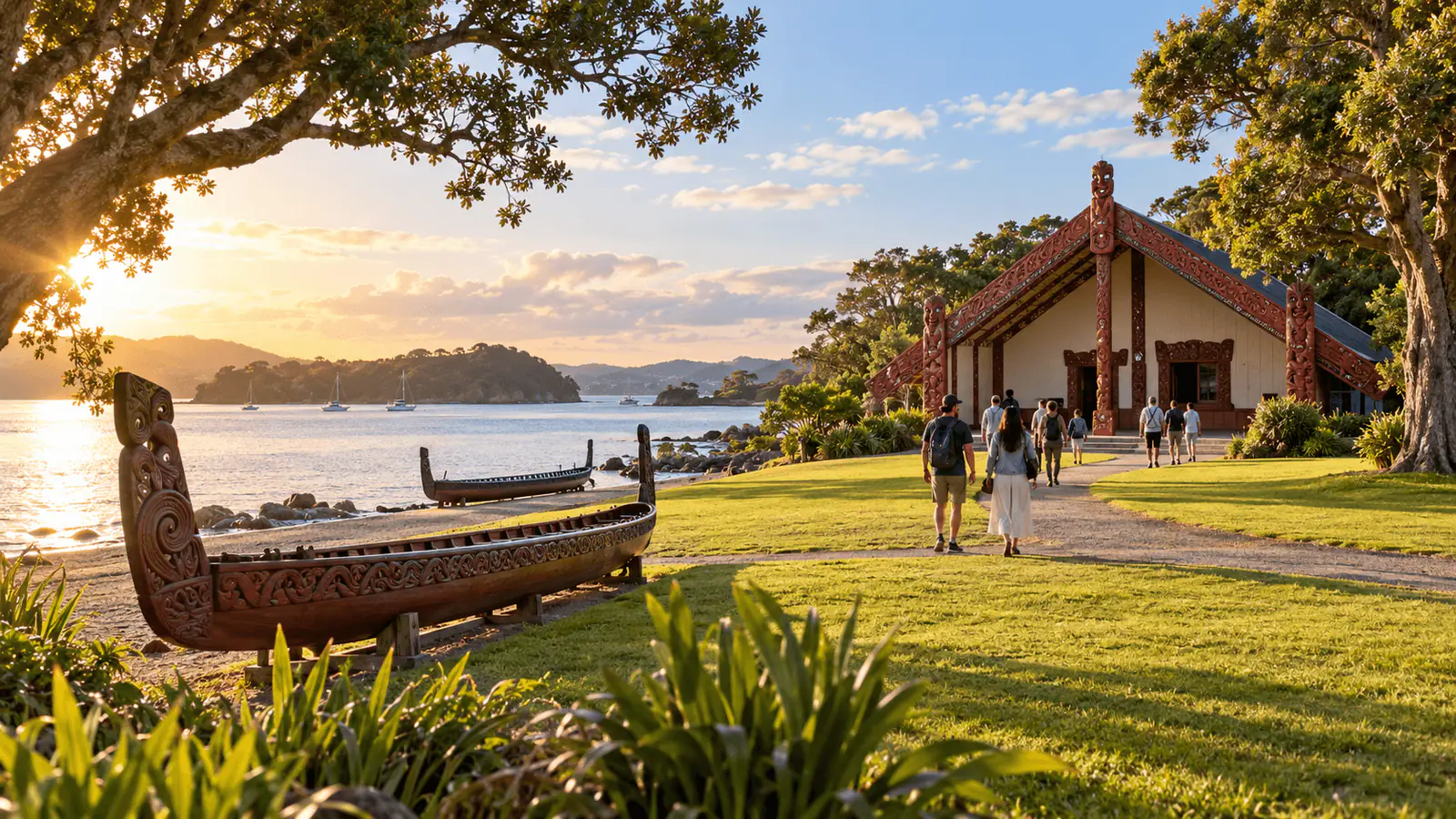
Conceptual illustration (AI-generated). Not a photograph of the actual Treaty Grounds or any Waitangi Day ceremony.
Waitangi Day is New Zealand's national day, and it is unlike a typical national holiday. It marks the signing of the Treaty of Waitangi, Te Tiriti o Waitangi, on 6 February 1840, the founding document that continues to shape the country's law, politics and relationships between Māori and the Crown. For many New Zealanders it is a day for reflection, debate and community gathering as much as for celebration, and it is observed in very different ways around the country.
This guide is for visitors who want to understand what the day means and plan a trip around it, particularly one that includes the Waitangi Treaty Grounds in the Bay of Islands, where the Treaty was first signed. It gives the confirmed 2027 calendar dates, explains the history and why it matters, and describes what the Treaty Grounds publish about the day. It is also careful about what is not yet known: the full 2027 programme had not been published when this guide was prepared in mid-October 2026, so descriptions of customary activities are labelled as customary, not as confirmed plans for 2027.
Waitangi Day 2027 at a Glance
| Item | Details | Confirmation status |
|---|---|---|
| Waitangi Day | Saturday 6 February 2027 | Confirmed (official public holiday calendar) |
| Observed public holiday | Monday 8 February 2027 | Confirmed (official public holiday calendar) |
| Main event site | Waitangi Treaty Grounds, Bay of Islands (about 2 km from Paihia) | Location confirmed by the Treaty Grounds |
| 2027 programme | The Treaty Grounds say the full 2027 programme will be available in January | Not yet published; do not rely on past programmes |
| Customary format | Described by the Treaty Grounds as a free festival starting with a 5am dawn service, with all-day entertainment and market stalls | Customary description; 2027 details to be confirmed |
| Nearby holiday | Auckland Anniversary Day is observed on Monday 1 February 2027 | Confirmed (official public holiday calendar) |
What Is Waitangi Day?
Waitangi Day commemorates the first signing of the Treaty of Waitangi on 6 February 1840 at Waitangi in the Bay of Islands. It is a public holiday, and it is the occasion on which New Zealanders reflect on the Treaty, its promises and how they have been honoured. The day is marked by official ceremonies and community events, by cultural performances, and by discussion and, at times, protest about Treaty issues. That mix of commemoration and debate is part of what makes the day distinctive, and visitors should expect the mood to vary by place and by event.
The Waitangi Treaty Grounds, where the signing took place, is the best-known site for the day. The Treaty Grounds are operated as a place of historical and cultural significance, with a museum, historic buildings and a carved meeting house, and on Waitangi Day they become a festival site. Other communities hold their own events, and other people spend the day with family or at the beach, so you will see very different ways of marking it.
Understanding Te Tiriti o Waitangi / The Treaty of Waitangi
The Treaty exists in two texts, one in te reo Māori and one in English, and understanding that is the key to understanding the continuing conversation around it. On 6 February 1840 the Treaty was signed at Waitangi in the Bay of Islands by Captain William Hobson, several English residents and between 43 and 46 Māori rangatira (chiefs), according to the government's Treaty history resources. Copies were then taken around Northland and the rest of the country for further signatures, and by the end of 1840 more than 500 Māori had signed, including 13 women. The English text was signed only at Waikato Heads and Manukau, by 39 rangatira, so the large majority of signatures are on the te reo Māori text.
The two texts are not exact translations of each other, and the differences are central to the debate. In the first article, the te reo Māori text gives the British kāwanatanga, a right of governance, while the English text has Māori ceding sovereignty, a concept that had no direct Māori equivalent. In the second article, the te reo Māori text upholds rangatiratanga, the authority of rangatira and their people over their lands and taonga (treasures), while the English text guarantees undisturbed possession of property. The English text also gives the Crown an exclusive right of pre-emption, meaning only the Crown could buy Māori land, a provision that Māori and the Crown understood differently. How these differences should be read has been, and remains, a matter of legal, historical and political discussion. For many Māori, Te Tiriti o Waitangi, the te reo Māori text that most rangatira signed, is the authoritative document.
The Waitangi Tribunal and Treaty settlements
A subject that is not a tourist attraction
Why February 6 Matters in New Zealand
February 6 matters because it is the date of the first signing at Waitangi, and the day has become the symbolic anchor for the Treaty relationship. The significance is both historical and current. Historically, it marks the moment when the Treaty relationship between the Crown and many rangatira began. In the present, the day prompts national conversation about how the promises in the Treaty are honoured in law, government, land, language and everyday life.
In 2027, there is a calendar coincidence worth noting for planners. According to government holiday calendars such as Singapore's, Lunar New Year also falls on Saturday 6 February 2027, which means the Waitangi Day weekend overlaps with Lunar New Year celebrations in many cities. Travellers heading to Auckland for Lunar New Year events should note that the Auckland Lantern Festival is scheduled for later that month; see our Auckland Lantern Festival 2027 guide.
Waitangi Day 2027 Public Holiday and Observed Date
Waitangi Day itself falls on Saturday 6 February 2027. Because that is a weekend, New Zealand's official public holiday calendar lists the observed public holiday on Monday 8 February 2027, so many workers get a long weekend and many businesses will treat Monday as the holiday. Events marking the day itself, such as ceremonies at Waitangi, are generally held on 6 February, not on the observed Monday.
The long weekend affects travel. Roads to popular holiday areas, including Northland, are usually busy at the start and end of a long weekend, accommodation in the Bay of Islands can book out well in advance, and domestic flights and ferries may be fuller than usual. Auckland Anniversary Day is observed on Monday 1 February 2027, the week before, so travellers moving around Auckland and Northland may meet two busy weekends in succession. Dates come from the national public holiday calendar, and it is worth re-checking before you book anything non-refundable.
Visiting the Waitangi Treaty Grounds
The Waitangi Treaty Grounds is the historic site where the Treaty was first signed, and it is open to visitors through the year. The site's published information says admission includes a guided tour and a cultural experience, the Te Kōngahu Museum of Waitangi and the Te Rau Aroha Museum of the Price of Citizenship, Treaty House, Te Whare Rūnanga, the carved meeting house, and the waka taua, a ceremonial war canoe. The Treaty Grounds also lists a Hāngī and Concert evening experience that runs from October to April, and a coffee cart on the grounds. Visits can be booked online through the Treaty Grounds' booking portal, and the site publishes opening hours, admission details and directions on separate pages, so check those pages for current times and prices.
The Treaty Grounds are about two kilometres from Paihia, a walk of about 25 minutes or a drive of about two minutes, according to the Treaty Grounds. The 16-hectare site has boardwalks, concrete paths, tracks, beaches and lawns, which can be hard to navigate with restricted mobility. The Treaty Grounds publish an access guide, say Te Kōngahu Museum has a lift and Te Rau Aroha Museum has wheelchair access, and offer wheelchairs. They ask visitors to tell them about access needs when booking.
Visiting on Waitangi Day itself
What Visitors Can Experience During Waitangi Day
The Waitangi Treaty Grounds' own page describes the day's customary format, and it is useful for planning as long as you treat it as a description and not as a confirmed 2027 schedule. The page says the free festival at the Treaty Grounds starts at 5am with a dawn service in Te Whare Rūnanga, the carved meeting house. It describes all-day entertainment (the organiser's wording) on the Upper Treaty Grounds, at Te Korowai ō Maikuku and on the sports field opposite, more than 150 market stalls selling art, crafts, clothing and food, and children's activities that include bouncy castles, kids' racing cars and sports games. The page also notes that the 2026 programme and map are posted and that the 2027 full programme will be available in January.
These details come from the organiser's general description of the day and from the posted 2026 programme, so treat them as customary until the 2027 programme confirms them. Do not plan a precise itinerary around specific performers, ceremonies or times that have not been announced, and check the official programme as soon as it appears in January.
Confirmed, customary and unknown
Planning for an early start
Waitangi Day Events Across New Zealand
Waitangi is the best-known site, but it is not the only place that marks the day, and other New Zealand February events often cluster around it. Councils, iwi, community organisations, museums and schools across New Zealand hold their own events, and these range from formal ceremonies and cultural performances to community picnics, concerts and open days. Programmes are usually announced by the organisers closer to the date, and no specific 2027 events outside the Treaty Grounds had been confirmed when this guide was prepared, so check your local council's events listing and the websites of major museums and marae in the area you plan to visit.
Whichever event you choose, the same planning points apply. Confirm the date, as some events are held on the Saturday and others on the observed Monday or the weekend around it; check admission and access rules; and expect the format to vary between a commemorative event and a family festival. If you are visiting from overseas, a visit to a museum with Treaty exhibitions on a day other than 6 February can be a useful complement to attending an event.
How to Travel to Waitangi and the Bay of Islands
The Bay of Islands is in Northland, about three hours' drive north of Auckland, according to the Treaty Grounds' directions. The route runs north on State Highway 1 to Whangārei, on to Kawakawa and then to Paihia, and the Treaty Grounds are signposted beyond Paihia's waterfront road. Allow extra time at the start and end of the long weekend, because Northland roads are busy. The Treaty Grounds say visitor parking is free outside the main entrance, with more parking on Tau Henare Drive, and that a free shuttle runs between the Maritime Building in Paihia and the Grounds during the high season, from 1 October to 30 April excluding 25 December, on a first-come, first-served basis. They also note that shuttle times for 1 to 6 February may vary because of Waitangi Week commitments and possible road closures, so check the current times. Kerikeri Airport has domestic flights, so compare flights with driving and check schedules early, as seats can sell out on holiday weekends.
Once you are in the Bay, Paihia is the main base for the Treaty Grounds and for harbour activities, and a passenger ferry crosses from Paihia to Russell, the historic township across the water. Check the operator for timetables and fares, and expect reduced or altered services on public holidays. If you plan to travel by cruise ship, our guide to arriving in New Zealand by cruise or cargo ship explains the entry rules, and the Bay of Islands is a regular cruise stop. For more on how the Bay fits among the country's highlights, see our guide to top destinations for first-time visitors.
Where to Stay Near Waitangi and Paihia
Most visitors stay in Paihia, which is close to the Treaty Grounds and has a wide range of motels, hotels, backpacker hostels and holiday parks. Waitangi itself has a few options close to the grounds, Russell offers a quieter, historic base across the water, and Kerikeri and Opua are alternatives a short drive away. Staying within walking distance of the Treaty Grounds is a real advantage if you plan to attend an early-morning service.
Because Waitangi Day 2027 falls on a long weekend, and because Lunar New Year coincides, accommodation in the Bay of Islands can sell out months ahead. Book as early as possible, choose flexible cancellation terms if you can, and consider staying slightly outside the busiest areas with a clear transport plan. Prices usually rise for public holiday weekends, so compare options and avoid last-minute decisions.
A Three-Day Bay of Islands Cultural and Nature Itinerary
Day 1 (Friday 5 February): Auckland to the Bay of Islands
Day 2 (Saturday 6 February): Waitangi Day
Day 3 (Sunday 7 February): Nature and history on the water
Monday 8 February: Observed public holiday
February Weather and Seasonal Travel Conditions
February is high summer in New Zealand, so visiting New Zealand in February means warm weather and busy holiday destinations. New Zealand's climate agency NIWA's long-term averages (1991 to 2020) put Auckland's mean daily maximum at about 24.4°C in February and the mean daily minimum at about 16.6°C. Northland and the Bay of Islands are generally warm and humid in summer, but these are long-term averages and not a forecast for early February 2027. Showers, strong sun and occasional heavy rain can occur, and the tropical cyclone season runs through the summer, so ex-tropical storms can sometimes affect Northland with heavy rain and wind.
Pack sun protection, a hat, insect repellent and a light waterproof jacket, and bring warm layers for early mornings or boat trips. Check the forecast shortly before you travel, and allow flexibility in your plans in case of severe weather. For a broader look at the seasons, see our season guide to visiting New Zealand.
Public Holiday Opening Hours, Transport and Accommodation
On the observed holiday, Monday 8 February 2027, many businesses close or operate on reduced hours, and some public transport runs on holiday timetables. Waitangi Day is generally not a restricted trading day for shops in the way Christmas Day is, but individual businesses decide their own hours, and some cafés and restaurants add a public holiday surcharge that is shown on the menu or bill. Check opening hours for the specific attractions, tours and ferries you plan to use, particularly small operators, and book tours and tables ahead.
Buy groceries and fuel before you head to smaller Northland towns, and carry offline copies of bookings in areas with weak mobile coverage. Expect heavier traffic and fuller accommodation across the whole long weekend, and consider travelling on the Friday morning or the Sunday to avoid the worst of it.
Respectful Visitor Etiquette at Cultural Events
- Follow the guidance of hosts, stewards and kaumātua, and arrive early for ceremonies
- Ask before photographing or filming people, particularly during ceremonies, speeches and performances
- If you enter a wharenui such as Te Whare Rūnanga, follow the instructions given about footwear, behaviour and photography
- Do not touch carvings or taonga unless you are invited to
- Listen to the stories being told, and avoid treating cultural practices as entertainment only
- Dress comfortably and respectfully, with warm layers for early starts
- Remember that people hold a range of views on the Treaty, and be courteous in conversation
International Visitor Requirements and NZeTA Preparation
Whether you need an NZeTA depends on your nationality, your passport and your travel plans. Citizens of visa waiver countries and territories may be eligible for an NZeTA instead of a visitor visa, citizens of other countries generally need a visitor visa, and Australian citizens do not need either. Our country-by-country NZeTA information pages summarise the rules for many nationalities, and our comparison of an NZeTA and a traditional visa explains the difference.
Immigration New Zealand currently advises allowing 72 hours for NZeTA processing and notes that its checks can take up to three days, and applications can take longer if further checks are needed. No approval or timeframe can be guaranteed, and an NZeTA does not guarantee entry: immigration officers can refuse entry, for example if you cannot show enough funds or a way to leave. An NZeTA is linked to your passport, which must be valid for at least three months after you plan to leave New Zealand, and everyone entering must complete a New Zealand Traveller Declaration, which for air travel can be submitted from 24 hours before the journey begins. A separate International Visitor Levy generally applies to visitors who are not exempt, as explained in our levy guide.
Booking around a long weekend
Frequently Asked Questions
When is Waitangi Day in 2027?
Waitangi Day falls on Saturday 6 February 2027. Because that is a weekend, the observed public holiday is Monday 8 February 2027, according to New Zealand's official public holiday calendar.
Is Waitangi Day a public holiday for visitors?
It is a national public holiday, so many businesses close or reduce hours, particularly on the observed Monday. Check the hours of the attractions, tours and ferries you plan to use.
What is the 2027 programme at the Waitangi Treaty Grounds?
It had not been published when this guide was prepared. The Treaty Grounds say the full 2027 programme will be available in January. Their page currently shows the 2026 programme, which should not be treated as the 2027 schedule.
Is there a dawn service?
The Treaty Grounds describe the free festival as starting at 5am with a dawn service in Te Whare Rūnanga. That is their general description of the day, and the 2027 details are to be confirmed by the published programme.
Can I visit the Treaty Grounds museums on Waitangi Day?
The Treaty Grounds describe the buildings as closed on 6 February while the site becomes the festival site, so the usual guided visit may not be available. Plan your museum visit for another day and confirm the 2027 arrangements.
How far is Waitangi from Auckland?
About three hours' drive without traffic, via State Highway 1 through Whangārei and Kawakawa. Allow extra time on the long weekend.
Is it respectful for visitors to attend Waitangi Day events?
Yes. Events are open to visitors, and the most important thing is to attend respectfully: listen, follow the hosts' guidance, ask before photographing people and remember that the day carries deep significance for many New Zealanders.
Do I need an NZeTA to visit for Waitangi Day?
It depends on your nationality and passport. Citizens of visa waiver countries may be eligible for an NZeTA, others generally need a visitor visa, and Australian citizens do not need either. Check Immigration New Zealand for your circumstances.
Is the weather good in February?
February is summer and is typically warm, but weather is changeable and ex-tropical storms can occasionally bring heavy rain to Northland. Check a forecast before you travel and pack for sun and showers.
Waitangi Day 2027 Travel Checklist
- Confirm the date: Saturday 6 February 2027, with the observed holiday on Monday 8 February
- Check the Waitangi Treaty Grounds' 2027 programme when it is published in January
- Confirm your entry requirements and apply for any required NZeTA or visa as soon as flights are booked
- Check that your passport is valid for at least three months beyond your planned departure
- Book Bay of Islands accommodation, car hire, flights and tours early, as the long weekend is busy
- Plan around the Treaty Grounds' closed-to-normal-visits arrangements on 6 February
- Pack sun protection, insect repellent, a light waterproof jacket and warm layers for early mornings
- Learn some of the Treaty's history before you go, and read the material at the Treaty Grounds
- Follow the guidance of hosts and ask before photographing people
- Save offline copies of bookings, and allow extra travel time on the holiday weekend
Ready to Apply for Your NZeTA?
Start your New Zealand adventure today with a quick and easy NZeTA application
Request an NZeTA